
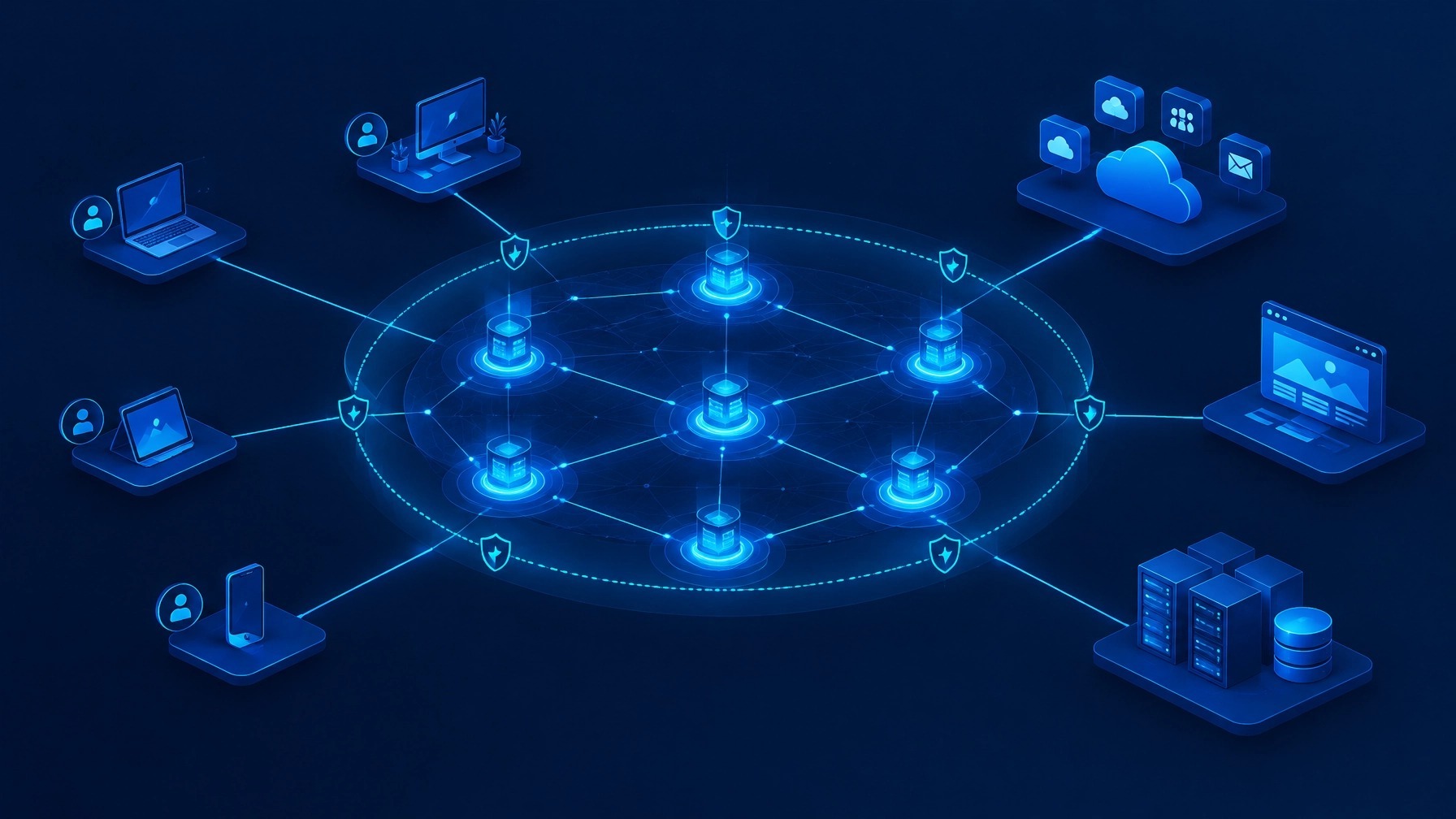
For years, many organizations treated security as a matter of protecting the office network: put firewalls at the edge, secure the data center, and control who gets inside. That model no longer reflects how business operates.
Employees work from home, on the road, and from customer sites. Core systems run in SaaS platforms and public clouds. Websites, APIs, and customer portals connect a company to the outside world, and often directly to revenue. The perimeter has not simply expanded. It has dissolved.
A global edge platform such as Cloudflare offers another way to protect and connect these services. Instead of relying only on hardware appliances at a central location, organizations can apply security and networking controls across a cloud-delivered network. For many mid-market companies, this makes enterprise-grade protection and performance that used to require an enterprise budget more accessible.
What Cloudflare does
Cloudflare describes itself as a global "connectivity cloud" spanning networking, security, and developer services. For web traffic, it can sit between users and an organization's Internet-facing applications, inspecting and routing requests before they reach the original infrastructure.
Cloudflare reports that its network proxies roughly 20% of the web, blocks an average of about 247 billion threats per day, and has data centers in more than 330 cities. It also reports approximately 50-millisecond latency to about 95% of Internet users. These are Cloudflare's figures, not a guarantee of performance or protection for every organization. You can read more in Cloudflare's overview.
The practical idea is straightforward: put more protection and delivery capability close to users, rather than requiring every organization to build and maintain that capability on its own premises.
Protect: Reduce exposure before traffic reaches your systems

DDoS protection
A distributed denial-of-service (DDoS) attack floods a website, application, or network with traffic in an attempt to overwhelm it. For a business, the result can be unavailable customer services, lost sales, frustrated users, and staff pulled away from planned work to respond.
Cloudflare offers unmetered DDoS mitigation for websites, applications, APIs, and networks. Its network-layer service, Magic Transit, is designed to protect on-premises and data center networks. The benefit of absorbing attack traffic at the edge is that less of it needs to reach the organization's own network or application infrastructure.
Web application firewall
A web application firewall, or WAF, filters requests to websites and applications. It can help identify and block common attacks such as SQL injection and cross-site scripting, which attempt to exploit weaknesses in how applications handle data or user input.
A WAF can be added in front of existing web infrastructure, helping provide a protective layer without requiring the organization to replace its application architecture. Like any security control, it still needs thoughtful configuration, monitoring, and testing.
Bots, APIs, and browser-side risks
Automated traffic is not always malicious, but abuse can take many forms: credential-stuffing attempts against login pages, scraping, inventory hoarding, and excessive requests that consume application resources. Cloudflare's Bot Management helps identify and manage automated traffic.
APIs, the interfaces that let applications and services exchange data, also need specific controls. Cloudflare's API Shield is designed to help discover and protect API endpoints. Rate limiting can restrict excessive requests, while Page Shield and client-side security address risks from scripts that run in a visitor's browser.
Cloudflare also offers email security. In its own materials, the company reports being named a Strong Performer in The Forrester Wave: Email, Messaging, and Security Solutions, 2025 Q2. Analyst assessments offer useful context, but they are not a substitute for evaluating fit against your organization's requirements.
Perform: Make digital services faster and more resilient

A content delivery network (CDN) caches eligible content closer to the people requesting it. This can reduce the distance a request travels, ease demand on origin servers, and improve delivery of a website or application. Cloudflare also offers Argo Smart Routing, which routes traffic across its network, and load balancing with health checks to direct requests toward available systems.
Speed is not just an IT vanity metric. A slow customer portal can make routine work harder for customers and partners. Delays in a checkout or quote process can affect conversions. For manufacturers, logistics providers, and other organizations with operational portals, a responsive service contributes to the experience customers associate with the business.
Performance gains depend on the application, configuration, and traffic patterns. A platform can provide tools for caching and routing, but it does not automatically make every application fast. Testing helps establish whether it improves the experience that matters to your users.
Connect: Apply access rules wherever people and systems work
Cloudflare One brings together networking and Zero Trust security services. Zero Trust means that access is based on verifying each request rather than assuming that a user or device is trusted simply because it is on a company network.
With Cloudflare Access, organizations can apply identity-aware access policies to internal applications, using context such as identity, device, location, and network conditions. This can provide an alternative to broad network access through a traditional VPN. Cloudflare describes its Zero Trust approach as requiring no hardware or complicated licensing, and says teams can start securing their first 50 seats for free. Available features depend on the plan and configuration.
Other Cloudflare One capabilities include Gateway for secure web gateway services and DNS filtering, which can help prevent malicious traffic from reaching user devices; a CASB (cloud access security broker) for SaaS visibility; and browser isolation to reduce exposure from risky web browsing. For network connectivity, Magic WAN and Magic Firewall offer software-defined options for connecting and protecting locations and networks.
DNS deserves special attention. It acts like the Internet's address book, directing requests for a domain to the appropriate service. If authoritative DNS is unavailable or compromised, users may not be able to reach a business's website or applications, even when those systems are otherwise running. Cloudflare offers authoritative DNS, DNSSEC (a method for helping validate DNS responses), domain registration, and certificate services including Universal SSL and Advanced Certificate Manager. These services can help organizations manage important parts of their public Internet presence in one place.
Cloudflare also presents a privacy-first approach, including end-to-end encryption, no ad-based revenue model, and data localization options through its Data Localization Suite. For organizations with regulatory or contractual obligations, those options need to be reviewed against the specific data flows, settings, and requirements involved.
The company has also reported being named a Visionary in the 2025 Gartner Magic Quadrant for SASE Platforms and receiving the second-highest Strategy score in The Forrester Wave: Zero Trust Platforms, Q3 2025. These are category-specific analyst assessments, not a guarantee that a product will fit every environment.
What an edge platform does not replace
Cloudflare can be an important layer, but an edge platform is not a complete security program. It does not replace endpoint detection and response (EDR), managed detection and response (MDR), backup and recovery, identity governance, or user training. Nor does putting a website behind an edge platform resolve weaknesses in the application itself or determine who should have access to sensitive information.
We recommend treating Cloudflare as part of a defense-in-depth design: each layer addresses different risks, and the layers should work together. Splashwire helps organizations assess how security and infrastructure controls fit together through services such as cybersecurity operations and infrastructure and cloud.
Questions to ask before adopting an edge platform
Before selecting a solution, leadership and IT teams should clarify:
- What traffic and systems will it cover? Identify public websites, customer portals, APIs, remote users, branch offices, and internal applications.
- How will it integrate with existing security tools? Confirm how alerts, policies, and incident response will work alongside EDR and MDR.
- Who owns the policies? Decide who configures access, reviews exceptions, and responds when a rule blocks legitimate work.
- What does it not replace? Document the controls that remain necessary, including endpoint security, backups, identity management, and staff awareness.
- How will we measure the result? Set practical goals for availability, performance, user experience, and administrative effort.
A practical next step
Organizations with revenue-generating websites, e-commerce services, logistics portals, public-facing government services, or manufacturer partner portals may have a strong reason to evaluate an edge model. It can also be relevant when a mid-market IT team needs stronger network security but cannot staff a 24x7 network operations function.
At Splashwire, we help businesses in Central Pennsylvania and across the Mid-Atlantic evaluate, architect, deploy, and manage solutions like Cloudflare as part of a broader security and infrastructure strategy. The right starting point is an assessment of what you expose, how people connect, and which controls are already in place, not a product pitch.
For a complimentary conversation about whether an edge security model fits your environment, email contact@splashwire.com.