
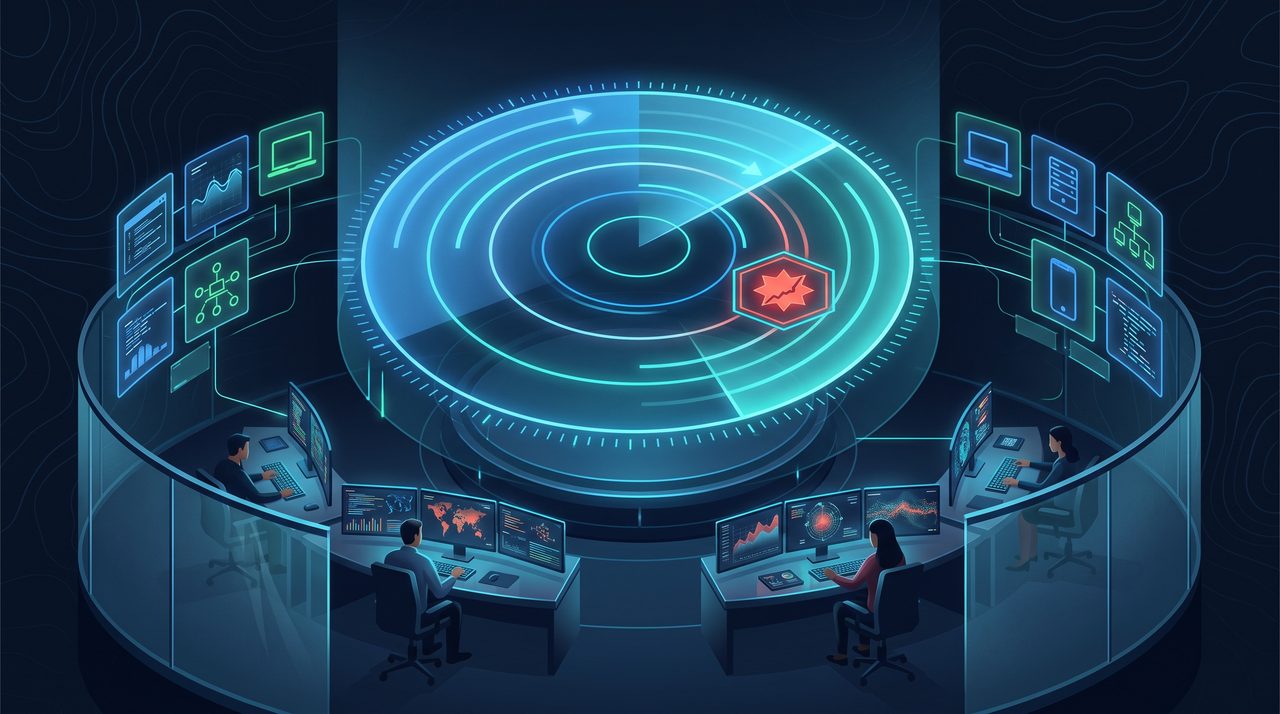
EDR (Endpoint Detection and Response) is the technology that watches your devices for threats. A SOC (Security Operations Center) is the team that monitors and responds. MDR (Managed Detection and Response) is the service that combines the technology and the team, delivering 24/7 detection and response without you building either in-house.
What is EDR?
Endpoint Detection and Response is software on your laptops, desktops, and servers that continuously watches for malicious behavior — not just known malware signatures, but suspicious actions like a process trying to encrypt files. EDR can detect, alert on, and often contain threats at the endpoint. On its own, though, EDR still needs someone to investigate and act on what it finds.
What is a SOC?
A Security Operations Center is the team and process that monitors security alerts around the clock, investigates them, and responds. A SOC turns raw alerts into decisions — is this a real attack, and what do we do about it? Building an in-house SOC requires skilled analysts working 24/7, which is out of reach for most small and mid-sized organizations.
What is MDR?
Managed Detection and Response is the service that delivers both the technology and the team as a subscription. An MDR provider deploys detection tools across your environment and pairs them with an expert team that monitors, investigates, and responds on your behalf — typically 24/7. You get enterprise-grade detection and response without hiring analysts or running a SOC yourself.
How they fit together
| Term | What it is | Think of it as |
|---|---|---|
| EDR | Endpoint security technology | The sensor |
| SOC | Security team and process | The team |
| MDR | Service combining tools + team | The whole solution, delivered |
Which does your business need?
If you have the budget and talent to staff analysts 24/7, you might run your own SOC with EDR tooling. Most organizations do not — and that is exactly the gap MDR fills. Given that more than 70% of incidents originate from inside the perimeter, where a firewall and antivirus cannot help, having a team watching and ready to respond is the difference between a contained event and a breach.
How Splashwire delivers MDR
Splashwire pairs next-generation endpoint protection and Cynet XDR with our own Security Operations Center, backed by 24/7 managed detection and response — so threats are caught and contained while your team focuses on the business. Explore our cybersecurity services and Cynet partnership.
Frequently asked questions
EDR is the endpoint security technology that detects threats on your devices. MDR is a service that combines that technology with an expert team who monitors and responds 24/7, so you are not just buying a tool — you are buying outcomes.
A SOC is the team and process that monitors and responds to security alerts. MDR is a service that delivers a SOC plus the detection technology as a subscription, so you do not have to build and staff one yourself.
If you cannot staff security analysts around the clock — which is most small and mid-sized organizations — MDR provides 24/7 detection and response that would otherwise be out of reach.