Reliable IT support is no longer a nice-to-have. For many organizations, it is a direct factor in employee productivity, service continuity, and risk management. As businesses grow, the question is not simply whether support is needed. The more practical question is: Should you augment your internal IT team or outsource the help desk entirely?
At Splashwire, we typically help clients evaluate two models. One is to augment an existing IT function with additional service coverage and specialized expertise. The other is to outsource the help desk to a dedicated external team that can provide broader coverage and operational consistency. Both approaches can be effective. The right fit depends on your internal resources, business hours, service expectations, and budget model.
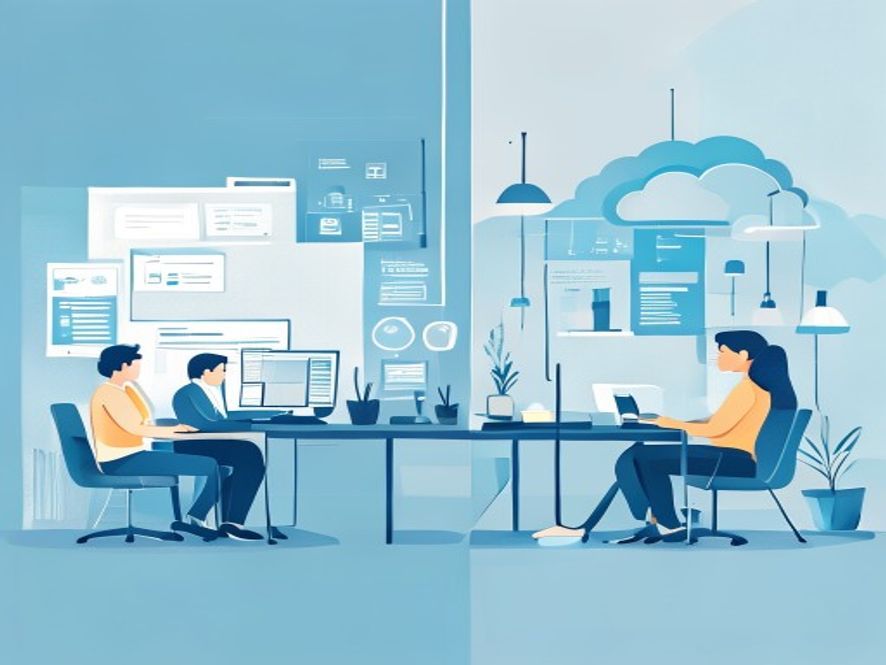
Augment vs. Outsource: What Each Model Means
There is no one-size-fits-all answer in IT. That is why our IT support services are designed to align with how each organization operates.
1. Augmenting Your Existing Team
Augmenting means your internal IT staff remains in place, while Splashwire supports them as an extension of the team. This model makes sense when you already have capable in-house personnel but need stronger coverage, additional capacity, or access to skills that may not be practical to hire for internally.
Augmentation is often the right choice when:
- Your internal team is stretched too thin: We help absorb ticket volume so internal staff can stay focused on strategic work.
- You need after-hours coverage: We provide support during nights, weekends, and other periods when internal staffing may be limited.
- You need specialized expertise: We can complement your team with deeper experience in areas such as security, infrastructure, and vCISO or strategic leadership.
In this model, your internal team keeps ownership of IT direction and business context, while we strengthen day-to-day support delivery.
2. Fully Outsourced Help Desk
Outsourcing means Splashwire becomes the primary help desk function for your organization. This approach is often a strong fit for companies that want to simplify operations, improve service consistency, or avoid the cost and complexity of building a 24×7 support structure in-house.
Outsourcing often makes sense when:
- You want broader coverage without adding headcount: A fully managed help desk can provide continuous support without the overhead of recruiting, training, and retaining a round-the-clock internal team.
- You need a predictable operating model: Support is delivered through a monthly service structure that helps convert what might otherwise be significant capital and staffing investments into manageable operating expense.
- You want scalable expertise: As your environment changes, you gain access to a broader bench of professionals across cloud services, security, and infrastructure.
For many organizations, the key advantage is financial and operational predictability. Rather than making large CapEx-style investments in tools, staffing, and support infrastructure, companies can move to an OpEx-oriented model with clear monthly costs and service expectations.
The Tools Behind Effective Service Delivery
Strong help desk support depends on more than staffing. The quality of service is directly influenced by the tools and processes behind it. At Splashwire, our 24×7 US-based support model combines experienced technicians with a technology stack designed to improve speed, visibility, and consistency.
AI-Led Technology
AI-led technology helps us make support more efficient and more consistent. Used appropriately, it can assist with ticket routing, knowledge surfacing, pattern recognition, and documentation. That means technicians spend less time searching for repetitive answers and more time resolving issues that require judgment and experience.
The value is not automation for its own sake. The value is faster triage, better context, and a more consistent support experience for end users.
RMM (Remote Monitoring & Management)
RMM tools allow us to monitor systems continuously, automate routine maintenance, and identify issues before they become user-facing disruptions. This changes service delivery from reactive to proactive.
In practice, RMM supports:
- Continuous visibility: Devices and infrastructure can be monitored for performance, health, and alert conditions.
- Preventive action: Patch management, maintenance tasks, and remediation steps can often be handled before they create downtime.
- Operational efficiency: Technicians have better insight into the environment, which reduces investigation time and improves response quality.
EDR (Endpoint Detection & Response)
Modern help desk service also needs to account for security. IT security and support operations are closely connected, especially when endpoints are the front line for both productivity and risk.
EDR improves service delivery by helping teams:
- Detect suspicious activity quickly: Threat indicators can be identified earlier, reducing response time.
- Support containment and response: Security events can be escalated and addressed with better context.
- Protect the user environment: Support is not limited to functionality alone; it also includes maintaining a safer operating environment for the business.
Together, AI-led workflows, RMM, and EDR create a more mature service model. They help reduce downtime, improve ticket handling, and support a more secure and consistent end-user experience.
Why 24×7 US-Based Support Fills the Gap
Many organizations operate beyond traditional business hours, even if their help desk does not. Employees work early, stay late, travel, log in remotely, and rely on systems outside the bounds of a standard 8-to-5 support window. When help is only available during business hours, delays become costly. A simple access issue, device problem, or service interruption can quickly affect productivity, customer response times, and internal momentum.
That is where 24×7 US-based support adds practical value.
By keeping support available around the clock, organizations can:
- Reduce downtime outside standard hours: Issues can be addressed when they happen, not when the help desk reopens.
- Support distributed and flexible workforces: Employees in different locations and schedules still receive timely assistance.
- Improve service continuity: Support coverage aligns more closely with how modern businesses actually operate.
- Strengthen communication: US-based support helps maintain clarity, responsiveness, and familiarity in day-to-day interactions.
For many companies, this is not only a service improvement. It is also a budgeting improvement. A monthly support model provides more predictable costs and can reduce the uncertainty that comes with ad hoc staffing decisions, emergency coverage gaps, and one-off support expenses. Instead of carrying large investments in internal coverage infrastructure, businesses can align support with an OpEx model that is easier to forecast and manage.
Which Model Is Right for You?
If you are evaluating your next step, a few questions can help clarify the best fit:
- Do you already have an internal IT team that understands the business well but needs additional capacity or after-hours coverage? If so, augmentation is often the better path.
- Do you want to simplify support operations and move to a predictable monthly service model? If so, outsourcing may provide stronger long-term value.
- Does your organization rely on systems, staff, or workflows outside normal business hours? If so, 24×7 US-based coverage can address a service gap that many internal teams are not designed to fill alone.
At Splashwire, we focus on helping organizations simplify how technology is consumed and improve how it is experienced. Whether that means supporting your internal team or serving as your primary help desk, the objective is the same: reliable service, better coverage, and a support model that fits the way your business operates.

Ready to Evaluate the Right Fit?
Whether you need to extend the reach of your internal IT team or move to a fully outsourced help desk, the right model should improve coverage, support the user experience, and bring greater predictability to your operations.
If you are reviewing your current support structure, we would be glad to help you evaluate the best fit for your team, your budget, and your service expectations.
Contact us today to discuss the right support model for your organization.